Government of Pakistan Announces 20%
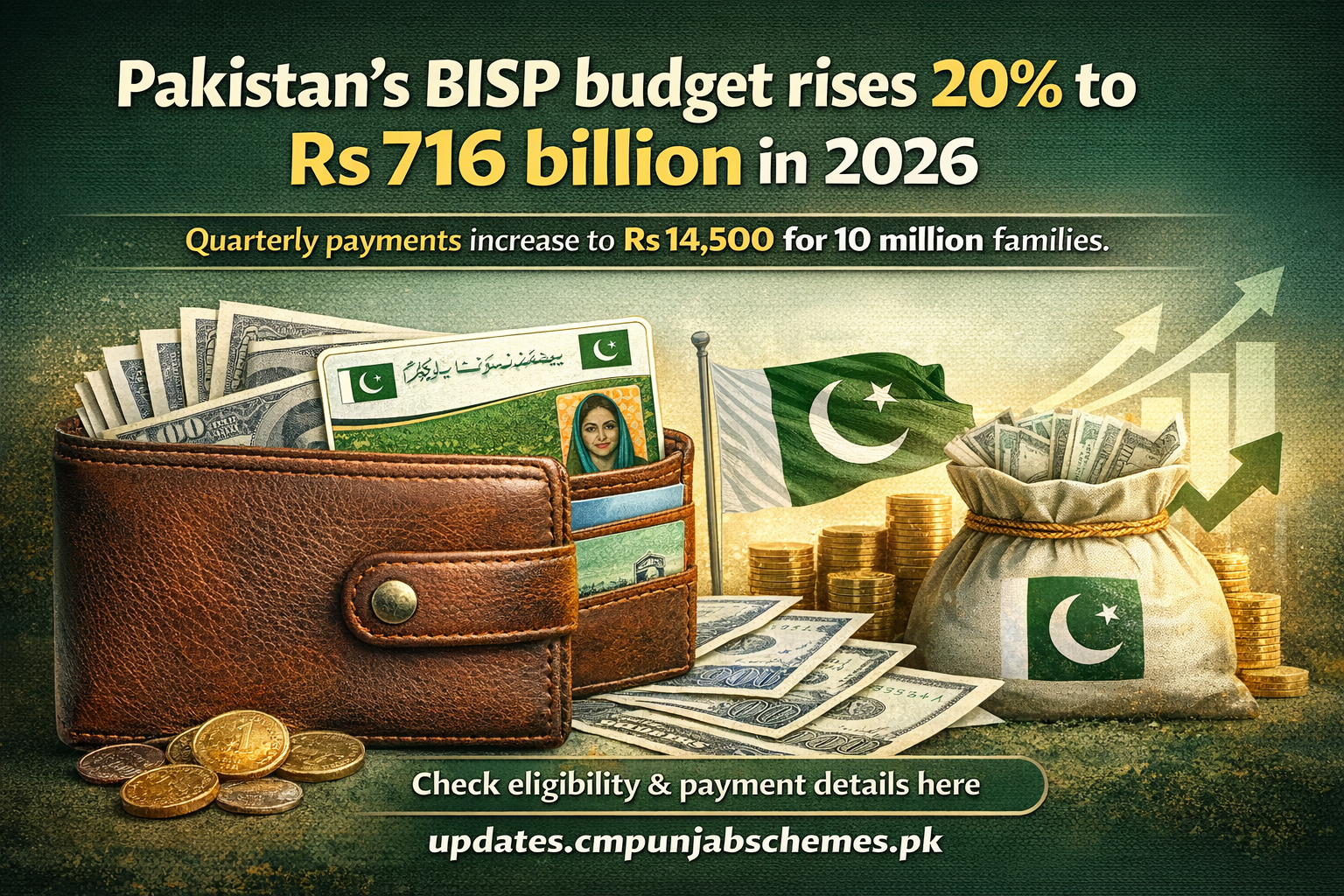
The Government of Pakistan has taken a monumental step toward poverty alleviation by approving a 20% increase in the Benazir Income Support Programme (BISP) budget for fiscal year 2026. The Ministry of Finance has allocated Rs 716 billion for BISP, marking a significant jump from the Rs 592.48 billion budgeted in the previous year. Starting January 2026, eligible women enrolled under the Benazir Kafalat Program will receive quarterly payments of Rs 14,500, up from the previous Rs 13,500.
This increase arrives at a critical time when inflation has severely impacted low-income households across Pakistan, making it difficult for families to afford basic necessities like food, healthcare, and education. For the approximately 10 million families depending on this assistance, the additional Rs 1,000 per quarter represents more than just numbers it’s hope for better nutrition, continued schooling for children, and dignity in meeting daily needs.
Also Read: BISP 8171 September Payment 2025
Understanding the BISP 8171 Budget Increase 2026
What Changed and When?
The 2026 budget expansion reflects Pakistan’s commitment to strengthening its social safety net. The increased allocation allows for an adjustment to Unconditional Cash Transfer (UCT) Kafaalat benefits to account for anticipated annual inflation in 2025, enabling the quarterly benefit to rise from Rs 13,500 to Rs 14,500 beginning January 2026.
Budget Breakdown: Where the Money Goes
| Budget Category | FY 2024-25 | FY 2025-26 | Increase |
|---|---|---|---|
| Total BISP Allocation | Rs 592 billion | Rs 716 billion | 20.9% |
| Quarterly Kafalat Payment | Rs 13,500 | Rs 14,500 | 7.4% |
| Target Beneficiaries | 9.3 million | 10 million | 700,000 new families |
The expanded budget supports three critical objectives:
Enhanced Services: Improving digital payment systems and reducing fraud
Inflation Relief: Helping families maintain purchasing power amid rising costs
Wider Coverage: Adding 700,000 new deserving families to the program
Why This Increase Matters: The Economic Context
Fighting Inflation with Targeted Support
Pakistan has experienced significant inflationary pressures over the past two years. Food prices, utility bills, and transportation costs have surged, eroding the purchasing power of the country’s poorest citizens. The government recognized that without adjusting BISP payments, the real value of assistance would diminish, leaving vulnerable families worse off.
According to economic experts, the additional Rs 1,000 quarterly payment can:
- Purchase a month’s supply of essential groceries like flour and rice
- Cover school uniforms or supplies for one child
- Pay a partial utility bill during winter or summer peaks
- Contribute toward basic healthcare needs or medications
Meeting International Commitments
The budget increase aligns with recommendations from international financial institutions, including the IMF and World Bank. The Finance Ministry has committed to the IMF to maintain annual inflation adjustments for UCT benefits, ensuring that the purchasing power of vulnerable families remains stable in real terms.
This commitment demonstrates Pakistan’s dedication to maintaining a sustainable social protection framework that adapts to economic realities rather than providing static support that loses value over time.
Also Read: BISP Wallet SIM 8171
Who Benefits from the BISP 8171 Kafalat 2026 Increase?
Current Beneficiaries: Automatic Upgrades
If you’re already enrolled in the Benazir Kafalat Program and have been receiving Rs 13,500 quarterly payments, you’ll automatically receive the increased amount of Rs 14,500 starting January 2026 provided your registration details remain current and verified.
The program prioritizes:
- Women-headed households: Female family members receive payments directly
- Low-income families: Those with Poverty Means Test (PMT) scores below 32-34
- Widows and divorced women: Facing economic hardship without spousal support
- Households with disabilities: Family members unable to work due to health conditions
- Families with school-age children: Supporting education through Taleemi Wazaif
New Enrollments: 700,000 Additional Families
The government is adding 700,000 new families to the program, increasing the total beneficiary base to 1 crore (10 million) women. This expansion targets previously excluded households that meet eligibility criteria but weren’t enrolled due to budget constraints.
Eligibility Criteria for BISP 8171 Kafalat 2026
Understanding whether you qualify for BISP assistance is crucial. The program uses a systematic approach to identify deserving families:
Primary Eligibility Requirements
Poverty Score (PMT): Your household must have a Poverty Means Test score below 32 (general applicants) or below 37 (widows and persons with disabilities). This score is calculated through the National Socio-Economic Registry (NSER) survey, which assesses:
- Monthly household income (must be below Rs 30,000)
- Housing conditions and ownership status
- Access to basic utilities
- Number of dependents and household size
- Educational levels of family members
Valid CNIC: The female head of household must possess a valid, non-expired Computerized National Identity Card registered with NADRA.
No Government Employment: Neither the applicant nor their spouse should work in a government position or receive government pensions.
Asset Restrictions: Applicants should not own:
- Luxury vehicles or multiple cars
- Extensive agricultural land (beyond subsistence farming)
- Commercial properties or businesses
- Bank accounts exceeding specified thresholds
Who Gets Priority?
The program gives special consideration to:
Households affected by natural disasters or economic shocks
Families with multiple children enrolled in school
Pregnant and lactating mothers needing nutritional support
Elderly citizens without other income sources
How to Check Your BISP 8171 Payment Status in 2026
The government has modernized the verification process, making it easier than ever to check your eligibility and payment status. Here are four convenient methods:
SMS Service (8171)
This is the quickest and most accessible option for those with basic mobile phones:
- Open your mobile phone’s messaging app
- Type your 13-digit CNIC number (without dashes)
- Send the message to 8171
- Wait 1-2 minutes for an automated reply
The response will indicate:
- Your eligibility status (Eligible/Ineligible)
- Payment amount available for withdrawal
- Whether you need to complete a survey or update information
Important: Use a SIM card registered in your own name to avoid technical errors.
Online Web Portal (8171.bisp.gov.pk)
For more detailed information, visit the official BISP web portal:
- Navigate to 8171.bisp.gov.pk in any web browser
- Enter your 13-digit CNIC number in the provided field
- Complete the CAPTCHA verification by entering the 4-digit code shown
- Click “Check Eligibility” or “Find Out”
The portal displays:
- Current eligibility status
- Payment release dates
- Any pending documentation requirements
- Links to register complaints or update information
BISP Helpline (0800-26477)
Speak directly with a BISP representative for personalized assistance:
- Call the toll-free number 0800-26477
- Provide your CNIC number to the operator
- Ask specific questions about your case
- Request guidance on resolving issues
Helpline hours: Monday to Friday, 8:00 AM to 5:00 PM
Visit BISP Tehsil Office
For complex issues or in-person verification:
- Locate your nearest BISP Tehsil Office (district-level office)
- Bring your original CNIC and any supporting documents
- Meet with a BISP officer who can:
- Update your NSER survey data
- Resolve biometric verification issues
- Explain discrepancies in your application
- Assist with new registrations
Payment Collection Methods: Where and How to Receive Rs 14,500
The government has implemented multiple payment channels to ensure convenient, secure, and transparent fund distribution.
BISP Campsites
The government has set up temporary campsites in private schools and government institutions where BISP officers are present to assist with the entire process.
How it works:
- Wait for an SMS notification from 8171 confirming your payment release
- Visit the designated campsite in your area (location sent via SMS)
- Bring your original CNIC
- Complete biometric thumb verification
- Receive your full Rs 14,500 in cash
Advantages:
- One-stop solution with BISP staff on-site
- Immediate assistance if verification issues arise
- Suitable for those without bank accounts
ATM Withdrawal (HBL & Bank Alfalah)
For beneficiaries who prefer privacy and convenience:
- Wait for SMS confirmation that payment is available
- Visit the nearest HBL or Bank Alfalah ATM
- Select the “BISP Withdrawal” or “Biometric Verification” option
- Place your thumb on the biometric scanner
- Collect your Rs 14,500 without needing a PIN or card
Important: Never share your biometric data with unauthorized individuals or pay “fees” to ATM agents. The full amount should be given to you without deductions.
Digital Wallets (JazzCash & Easypaisa)
If your status on the 8171 portal shows “Wallet Eligible,” you can receive your money directly in your JazzCash or Easypaisa account.
Benefits:
- Instant transfer once payment is released
- Use funds for mobile top-ups, bill payments, or shopping
- Transfer money to family members digitally
- Avoid traveling to physical locations
Authorized Retail Agents
For remote rural areas where banks and campsites are inaccessible:
- Payments can be collected from BISP-authorized agents
- Typically located at post offices or designated shops
- Biometric verification still required
- Service agents are monitored to prevent fraud
Registration Process: How to Enroll in BISP 8171 for the First Time
For New Applicants
If you’ve never received BISP assistance before, follow these steps:
Participate in the NSER Dynamic Survey
Unlike previous years, you cannot register entirely online. You must:
- Visit your nearest BISP Tehsil Office
- Request to be included in the Dynamic Survey
- Provide accurate information about your household
Gather Required Documents
Bring these documents to your registration appointment:
- Original CNIC (female head of household)
- B-Forms or CNICs of all children
- Utility bills (electricity, gas, water)
- Proof of residence (rental agreement or property documentation)
- Disability certificate (if applicable)
- Death certificate of spouse (for widows)
Complete the Survey Interview
A BISP enumerator will ask detailed questions about:
- Your household income sources
- Assets owned by family members
- Number of dependents
- Housing conditions
- Educational status of children
Await PMT Score Calculation
After completing the survey:
- Your information is entered into the NSER database
- A Poverty Means Test score is calculated automatically
- If your score falls below the threshold, you’re deemed eligible
- You’ll receive SMS notification of your status within 2-4 weeks
Biometric Verification
Once approved:
- Visit a BISP office or designated bank
- Register your fingerprints in the system
- Link your CNIC to the payment mechanism
- Activate your eligibility for quarterly payments
Enhanced Features and Improvements in 2026
Digital Transformation
Plans are advancing to expand BISP’s electronic payment system, which will provide beneficiaries with bank accounts to facilitate savings, with pilot projects expected to be operational in select districts by the first quarter of FY26.
This initiative will:
- Give beneficiaries formal banking access
- Enable savings for emergencies or future needs
- Reduce dependency on cash transactions
- Integrate families into the formal financial system
Transparency Measures
To combat fraud and unauthorized deductions:
QR Code Slip System: New payment slips with unique QR codes for verification
Token System: Numbered tokens at campsites to manage crowds and prevent favoritism
Separate Women’s Counters: Dedicated service areas to ensure privacy and dignity
Facial Verification: Additional biometric layer to prevent identity fraud
Real-Time Tracking: Beneficiaries can see payment status updates instantly through the 8171 portal
Education and Health Linkages
The budget increase also strengthens conditional cash transfer programs:
Benazir Taleemi Wazaif (Education Stipends):
- BISP exceeded the FY25 education CCT enrollment target of 10.4 million by 400,000, and is on track to achieve its nutrition CCT target of 2.1 million
- Children receive additional stipends for school attendance
- Amounts vary by education level (primary, secondary, higher secondary)
Maternal and Child Nutrition Support:
- The stipend for pregnant and lactating mothers has been increased, with eligible women receiving up to Rs 38,000 over the course of the program
- Payments tied to prenatal checkups and vaccination schedules
- Incentivizes healthcare utilization for better outcomes
Common Issues and How to Resolve Them
“Survey Required” Message
What it means: Your NSER data is outdated or incomplete.
Solution:
- Visit your BISP Tehsil Office immediately
- Request to participate in the Dynamic Survey update
- Complete within the deadline to avoid payment suspension
- Failure to complete the “Dynamic Survey” by the end of the month could lead to your CNIC being blocked from the Q2 (April) installment
Biometric Verification Failed
What it means: Your fingerprints don’t match NADRA records.
Solution:
- Visit the nearest NADRA office
- Request a “Mega Fingerprint” update
- Alternative: Get a manual payment voucher from BISP office
- Ensure your CNIC isn’t expired or blocked
Payment Deductions by Agents
What it means: Unauthorized individuals are taking “commissions” from your payment.
Solution:
- Never pay anyone to receive your BISP money
- Report incidents immediately to the BISP helpline: 0800-26477
- Use ATMs or official campsites where BISP staff supervise transactions
- File complaints through the 8171 web portal
CNIC Shows “Ineligible”
What it means: Your household doesn’t meet current eligibility criteria.
Possible reasons:
- PMT score is too high (above threshold)
- Government employee in the family detected
- Asset ownership exceeds limits
- Income sources reported above Rs 30,000/month
Solution:
- Request a detailed explanation at BISP office
- If circumstances have changed (job loss, divorce, etc.), request re-survey
- Appeal the decision with supporting documentation
Important Dates and Payment Schedule 2026
Quarterly Payment Calendar
| Quarter | Period | Expected Payment Release | Amount |
|---|---|---|---|
| Q1 2026 | Jan-Mar | January 15-31, 2026 | Rs 14,500 |
| Q2 2026 | Apr-Jun | April 15-30, 2026 | Rs 14,500 |
| Q3 2026 | Jul-Sep | July 15-31, 2026 | Rs 14,500 |
| Q4 2026 | Oct-Dec | October 15-31, 2026 | Rs 14,500 |
Note: Exact dates may vary by district. Always wait for official SMS notification before visiting payment centers.
Survey Deadlines
- Existing Beneficiaries: Complete Dynamic Survey update by end of February 2026
- New Applicants: Rolling enrollment throughout the year via NSER survey
- Re-appeals: Submit within 30 days of ineligibility notification
Impact Assessment: How the Increase Helps Families
Real-World Difference
For a typical BISP beneficiary family:
Before (Rs 13,500/quarter):
- Monthly equivalent: Rs 4,500
- Daily budget: Rs 150 per day
- Covered approximately 12-14% of consumption needs
After (Rs 14,500/quarter):
- Monthly equivalent: Rs 4,833
- Daily budget: Rs 161 per day
- Covers approximately 15% of consumption needs
While the Rs 1,000 increase may seem modest, for families living on the margin, it represents:
- 7.4% more purchasing power
- Ability to buy an extra 10-15 kg of wheat flour per quarter
- Coverage for one child’s school supplies
- Partial payment for one doctor visit or medication
Multiplier Effect on Local Economies
When 10 million families receive increased payments, the economic impact ripples through communities:
- Small shopkeepers see increased sales
- Agricultural markets benefit from higher food purchases
- Healthcare providers serve more patients
- Schools receive more tuition payments
- Local economies experience stimulated demand
Economic research shows that every rupee invested in social protection programs like BISP generates approximately Rs 1.50-2.00 in broader economic activity.
Comparison: BISP 2025 vs 2026
What Changed?
| Aspect | 2025 | 2026 | Change |
|---|---|---|---|
| Budget Allocation | Rs 592 billion | Rs 716 billion | +20.9% |
| Quarterly Payment | Rs 13,500 | Rs 14,500 | +7.4% |
| Beneficiary Families | 9.3 million | 10 million | +700,000 |
| Payment Methods | Cash, Basic ATM | Cash, ATM, Digital Wallets, Accounts | Enhanced |
| Transparency Tools | SMS, Portal | SMS, Portal, QR Codes, Facial Recognition | Advanced |
| Survey System | Periodic | Dynamic (Continuous) | Improved |
What Stayed the Same?
- Female head of household as primary recipient
- Biometric verification requirement
- PMT score-based eligibility
- Quarterly payment schedule
- 8171 verification system
- Integration with Taleemi Wazaif for education support
Safety Tips and Best Practices
Protecting Yourself from Fraud
Never share:
- Your CNIC number with unofficial callers
- Biometric thumbprints with agents asking for “verification fees”
- One-Time Passwords (OTPs) sent to your phone
- Bank account details with anyone claiming to be from BISP
Always verify:
- BISP only sends messages from 8171 (no other number)
- Official website is 8171.bisp.gov.pk (beware of fake sites)
- No legitimate BISP process requires advance payment
- Helpline 0800-26477 is toll-free (you shouldn’t be charged)
Maximizing Your Benefit
Do:
- Complete surveys promptly when requested
- Keep your CNIC valid and up-to-date
- Register children for Taleemi Wazaif if school-going
- Use digital wallets for safer transactions
- Report any deductions or issues immediately
Don’t:
- Miss survey deadlines (can result in payment suspension)
- Allow CNIC to expire (blocks payments automatically)
- Share biometric access with family members
- Withdraw payments through unofficial agents
- Ignore SMS notifications about status changes
Frequently Asked Questions (FAQs)
1. When will I receive the increased payment of Rs 14,500?
The new payment amount of Rs 14,500 begins with the January 2026 quarter (Q1 2026). If you’re already enrolled and verified, you’ll automatically receive the increased amount starting January 15-31, 2026, depending on your district’s payment schedule.
2. Do I need to reapply to get the Rs 14,500 payment?
No reapplication is necessary for existing beneficiaries. However, you must ensure your NSER survey data is current. If you receive a “Survey Required” message when checking your status, visit your BISP Tehsil Office immediately to update your information.
3. Can men receive BISP payments?
No, the Benazir Kafalat Program specifically designates the female head of household as the payment recipient. This policy promotes women’s economic empowerment and ensures funds reach those most likely to spend on family welfare.
4. What happens if my CNIC is expired?
An expired CNIC will block your ability to receive payments. Visit your nearest NADRA office immediately to renew your CNIC. Once renewed, update your information at the BISP office, and your payments will resume.
5. How can I check if I’m eligible for the first time?
Send your 13-digit CNIC number via SMS to 8171 or visit 8171.bisp.gov.pk. If the response says “Not Registered” or “Survey Required,” visit your nearest BISP Tehsil Office to participate in the NSER Dynamic Survey.
6. Is biometric verification still required in 2026?
Yes, biometric fingerprint verification remains mandatory for all payment collections. This security measure prevents fraud and ensures the rightful recipient receives the funds.
Conclusion: A Stronger Safety Net for Pakistan’s Most Vulnerable
The 20% increase in Pakistan’s BISP budget for 2026 represents far more than a budgetary adjustment it is a reaffirmation of the government’s commitment to protecting its most vulnerable citizens during challenging economic times. By raising the allocation to Rs 716 billion and quarterly payments to Rs 14,500, Pakistan is ensuring that social protection keeps pace with inflation and expanding to include hundreds of thousands of previously excluded families.
For the 10 million women who serve as anchors for their households, this increase offers renewed hope. It provides dignity through economic empowerment, enabling mothers to feed their children, keep them in school, and access basic healthcare without sacrificing one necessity for another. The program’s evolution incorporating digital payments, transparent verification systems, and real-time tracking reflects a modernization effort that respects beneficiaries’ time and dignity while combating fraud and inefficiency.
If you believe you qualify for BISP assistance, don’t wait. Send your CNIC to 8171 today, visit the web portal, or contact your nearest BISP office. The application process has been simplified, and the support you need may be just one survey away. For existing beneficiaries, ensure your information is current, complete any required surveys promptly, and utilize the safer payment methods now available, such as ATMs and digital wallets. The BISP 8171 Kafalat 2026 budget increase isn’t merely a government program it’s a promise to Pakistan’s families that they won’t face economic hardship alone. By working together to ensure eligible families access these benefits, we strengthen not just individual households but the social fabric of the entire nation.