Energy Vehicle Policy 2025
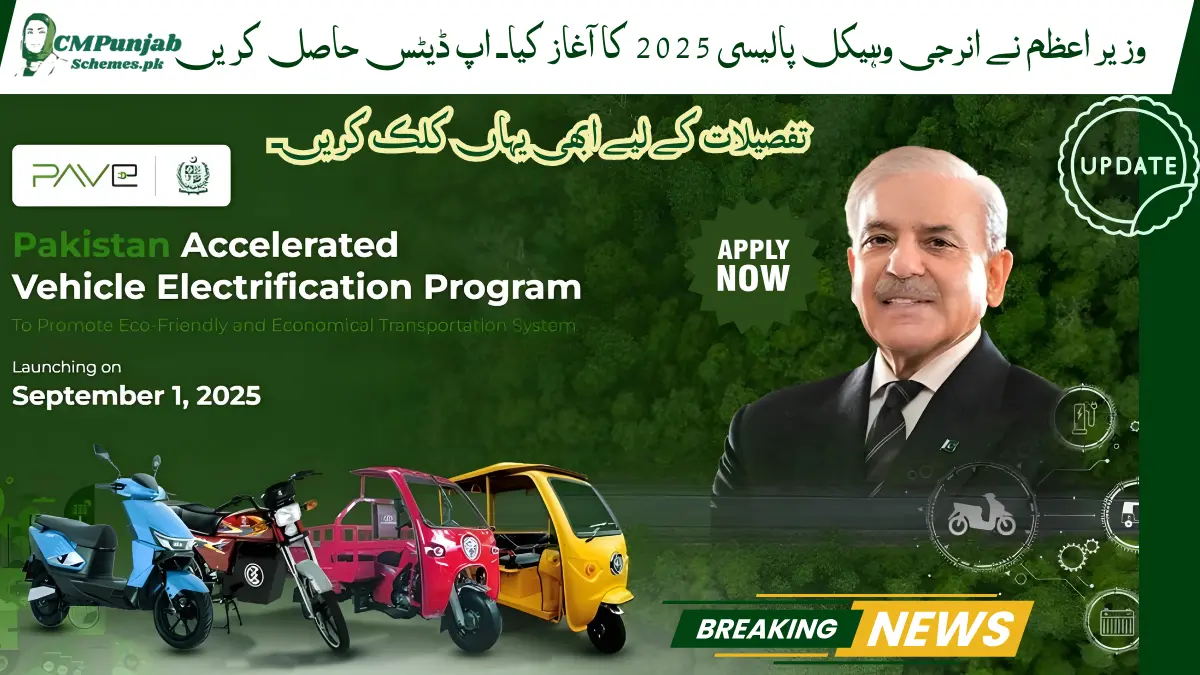
Pakistan’s bustling streets are filled with silent, emission-free vehicles, while families save thousands on fuel costs monthly. This isn’t a distant dream anymore. Prime Minister Shehbaz Sharif just turned this vision into reality with the groundbreaking Energy Vehicle Policy 2025.
The policy, launched in August 2025, marks Pakistan’s boldest step toward sustainable transportation. With climate disasters claiming over 700 lives this year alone, the timing couldn’t be more critical.
Breaking Down the Revolutionary Subsidies
Cash Incentives That Make EVs Irresistible
The government isn’t just talking green—they’re putting serious money behind it. With an initial allocation of Rs 9 billion, the Energy Vehicle Policy 2025 offers game-changing subsidies that slash EV prices dramatically.
Here’s what you’ll get:
- Electric bikes: PKR 65,000 subsidy per unit (covering 116,053 bikes initially)
- Electric rickshaws: PKR 400,000 subsidy per unit (3,171 units covered)
- Electric cars: PKR 15,000 per kWh battery capacity
These aren’t just numbers—they represent 20-25% savings on your initial investment. Imagine buying an e-bike at nearly the same price as a traditional 70cc petrol bike!
Tax Benefits That Sweeten the Deal
The policy slashes taxes dramatically. While conventional vehicles face 17% GST, EVs enjoy just 1%. Import duties on batteries and charging equipment drop from 20% to merely 1%. Plus, EV owners get free registration—a benefit that saves thousands more.
Infrastructure Revolution: Charging Stations Everywhere
The 3,000-Station Promise
Gone are the days of “range anxiety.” The Energy Vehicle Policy 2025 promises 3,000 charging stations nationwide by 2030. Within just six months, 40 fast chargers will dot major motorways and highways.
Oil marketing companies must convert 10% of their filling stations to EV charging sites. The government has fixed commercial charging rates at Rs 39.7 per kWh—making charging cheaper than your morning chai routine.
Read more about: Punjab Solar Tubewell Project 2025: A Ray of Hope for Farmers
Women Leading the Charge
Here’s something revolutionary: 25% of electric bike subsidies are reserved exclusively for women. The policy actively supports women entrepreneurs in courier services and ride-hailing platforms.
This isn’t tokenism—it’s transformation. Women across Pakistan can now access easier financing for EV businesses, breaking traditional barriers.
Why this policy matters
A real financing plan
Instead of vague promises, the PM Energy Vehicle Policy 2025 ties subsidies and infrastructure to an ICE-vehicle levy—money in, money out—making the transition fiscally credible
Read more about: How to Withdraw BISP 8171 September Payment 2025 Without Any Trouble
From policy to pavements
The Engineering Development Board is the implementing arm and has already moved on tenders and industry coordination, underscoring execution—not just aspiration.
How to apply (PAVE e-bike & e-rickshaw)
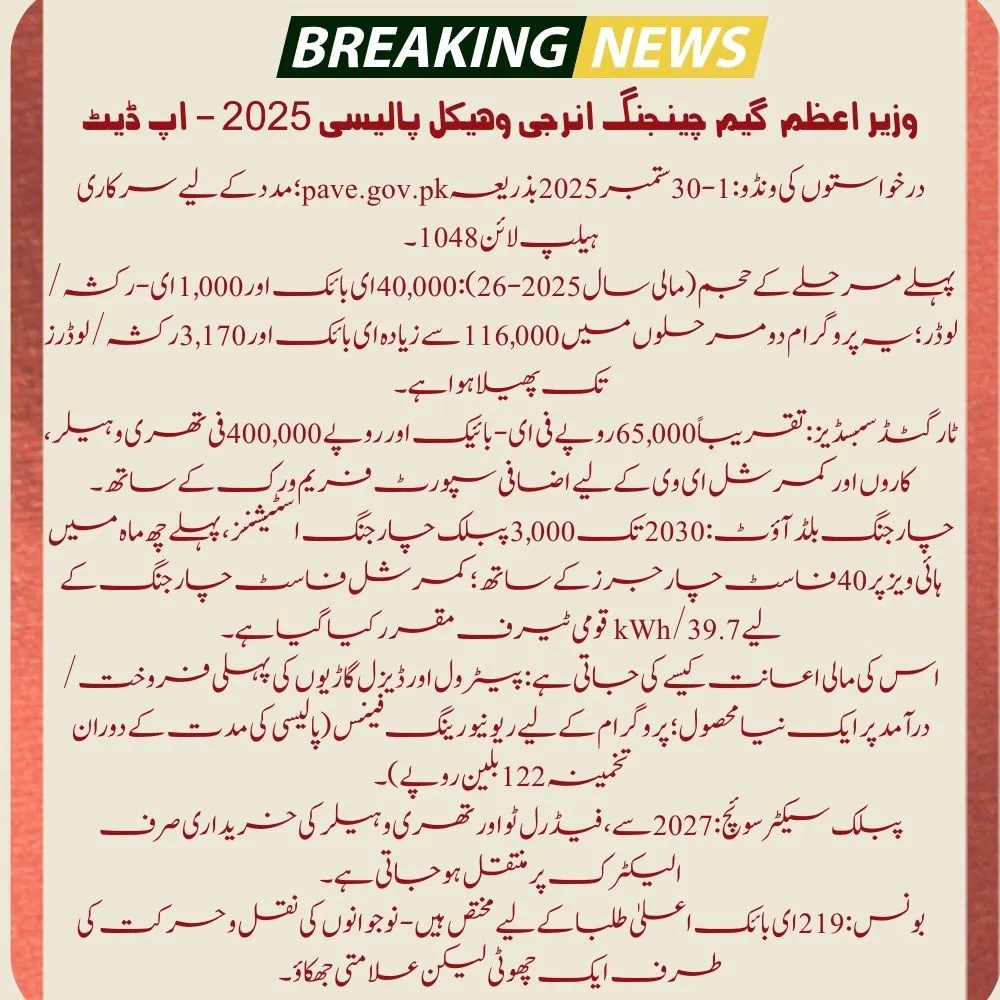
- Visit pave.gov.pk between 1–30 September 2025 and register.
- Upload required info (CNIC, contact, category).
- Watch for updates via the portal or helpline 1048.
- If selected, complete purchase and verification as directed by the implementing agency (EDB/MOIP).
These steps follow the official advertisement and EDB rollout notes for the Energy Vehicle Policy 2025.
Latest updates at a glance
- Applications window: 1–30 September 2025 via pave.gov.pk; official helpline 1048 for support.
- First phase volumes (FY 2025–26): 40,000 e-bikes and 1,000 e-rickshaws/loaders; the program expands to over 116,000 e-bikes and 3,170 rickshaws/loaders across two phases.
- Targeted subsidies: around Rs65,000 per e-bike and Rs400,000 per three-wheeler, with additional support frameworks for cars and commercial EVs.
- Charging build-out: 3,000 public charging stations by 2030, with 40 fast chargers on highways in the first six months; a Rs39.7/kWh national tariff set for commercial fast charging.
- How it’s funded: a new levy on the first sale/import of petrol and diesel vehicles; revenues ring-fenced for the program (estimated Rs122 billion during the policy period).
- Public sector switch: From 2027, federal two- and three-wheeler purchases shift to electric only.
Bonus: 219 e-bikes are reserved for top students—a small but symbolic nudge toward youth mobility.
read more about CM Punjab Electric Vehicles Programme 2025 – Latest Updates, Prices & Benefits
Momentum you can measure
- 65+ local manufacturers licensed for e-bikes/rickshaws; two for electric cars/SUVs as of mid-2025.
80,000+ EVs already on the road (mostly two/three-wheelers). - Numbers like these suggest the Energy Vehicle Policy 2025 is landing in a market that’s finally warming up.
Timeline and Implementation
Critical Milestones Ahead
The government isn’t dragging its feet. From 2027, all federal government purchases of two and three-wheelers must be electric. Islamabad transforms into Pakistan’s first model “electric mobility city”.
The policy targets 30% EV adoption by 2030, jumping to 50% by 2040. By 2060, Pakistan aims for a completely net-zero transport fleet.
Summary Table Energy Vehicle Policy 2025
| Item | Detail |
| Policy name | New Energy Vehicle (NEV) Policy 2025–30 / Energy Vehicle Policy 2025 |
| Implementer | Engineering Development Board (EDB), MOIP |
| Application window | 1–30 Sept 2025 (pave.gov.pk; helpline 1048) |
| First-phase volumes | 40,000 e-bikes; 1,000 e-rickshaws/loaders |
| Total rollout (2 phases) | 116,000 e-bikes; 3,170 rickshaws/loaders |
| Subsidy signals | ~Rs65,000/e-bike; ~Rs400,000/3-wheeler : PKR 15,000/kWh E Cars : 25% of bike subsidies (Women Quota) |
| Charging network | 3,000 stations by 2030; Rs39.7/kWh fast-charge tariff |
| Funding source | ICE levy (projected Rs122b) |
| EV Sales Target | 30% by 2030 |
| Public sector shift | All federal 2–3 wheelers electric from 2027 |
FAQs Energy Vehicle Policy 2025
Final Thoughts
The Energy Vehicle Policy 2025 isn’t just another government document—it’s Pakistan’s ticket to a cleaner, cheaper, and more sustainable future. The clock’s ticking, and the subsidies won’t last forever. If you’ve been waiting for a cue to go electric, The Energy Vehicle Policy 2025 just gave you one—clear deadlines, tangible subsidies, and a national plan that finally feels built to deliver.